Native vs. Spanish Bluebells: How to Identify and Manage Both
Every April the same question arrives: are these bluebells native, or are they the Spanish ones? It matters more than most gardeners expect. A clump of Spanish bluebells at the edge of a wood can change the character of that wood within a couple of decades, and once hybrids take hold, unpicking them is slow work. The good news is that the two are straightforward to tell apart once you know what to look at.
Why the distinction matters
The native bluebell, Hyacinthoides non-scripta, is a woodland plant of the Atlantic fringe — Britain, Ireland, northern France, the Low Countries. It grows slowly, flowers in a deep violet-blue, and depends on dappled spring light under deciduous trees. Spanish bluebells, Hyacinthoides hispanica, come from Iberia and were planted in gardens for a century or more precisely because they are tough: they take sun, dry shade, clay and neglect.
That toughness is the problem. Spanish bluebells set seed freely and split into offsets, so a modest clump becomes a dense mat. They also cross with natives. The resulting hybrid, Hyacinthoides × massartiana, is fertile and backcrosses with both parents. The outcome is a swarm of intermediates that gradually erodes the native type — not a dramatic invasion, but a slow dilution.
Four checks that settle it
One flower is rarely enough. Look at a whole clump in full flower and work through these:
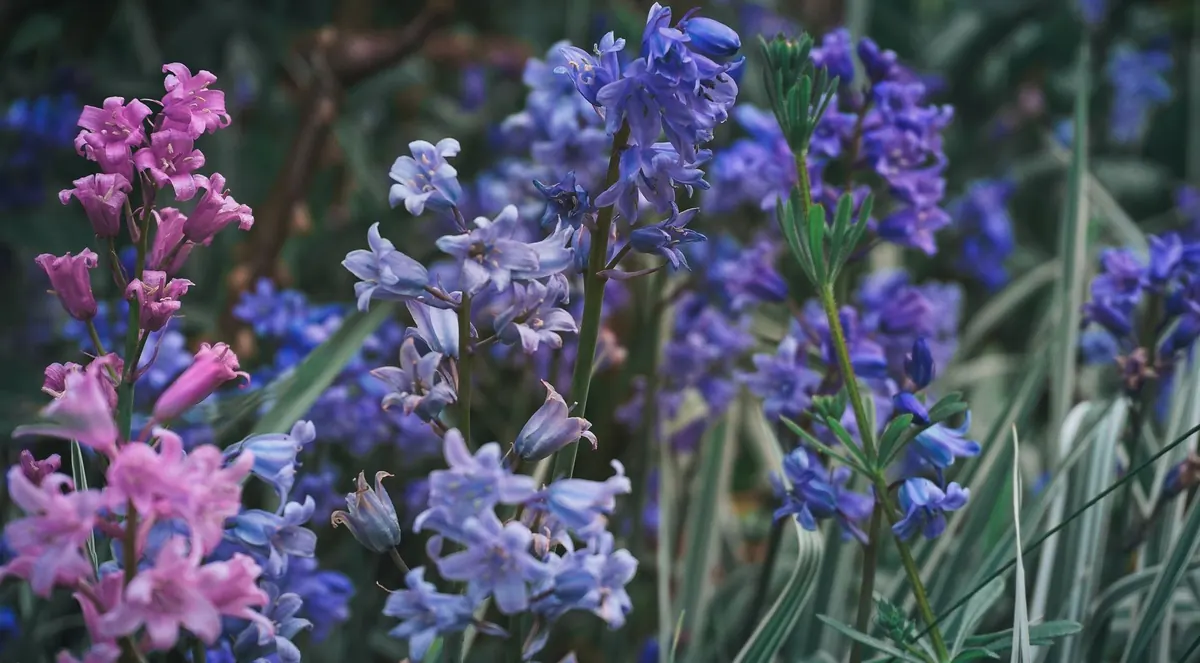
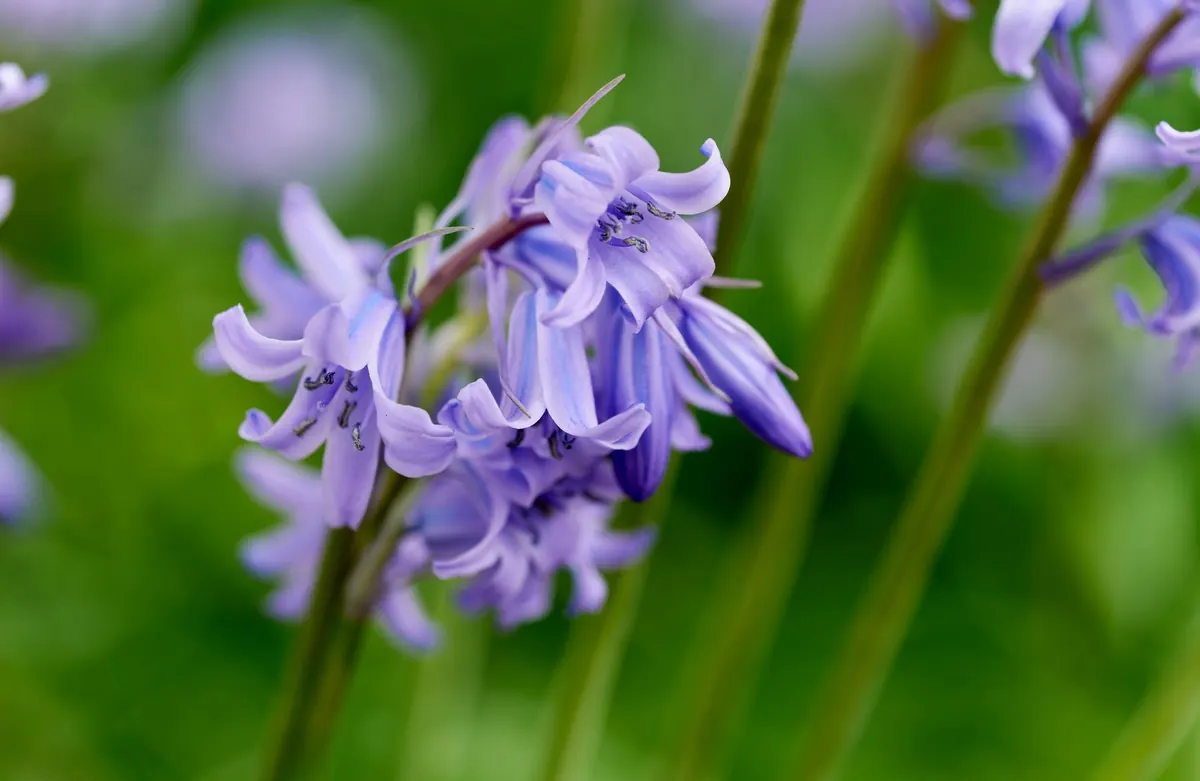
- Flower arrangement. Native: flowers hang from one side of the stem in a nodding row, so the spike looks swept to one side. Spanish: flowers sit all round the stem, opening outward and more upward.
- Flower shape. Native: a narrow tube with the petal tips curled back, like a small shuttlecock or a skirt turned inside out. Spanish: a broad, open cone or bell, with tips that flare only slightly and do not curl.
- Anthers. The pollen-bearing anthers inside the bell are the single most reliable check. Native: cream or pale green. Spanish: blue or purple.
- Scent. Native: strong and sweet, close to honey, filling the air on a warm evening. Spanish: faint to absent. If you can smell a clump from a metre away, that is a good sign.
- Leaves and stems. Native: narrow strap leaves, roughly a centimetre wide, on stems that arch at the top. Spanish: broad, glossy leaves up to three centimetres wide on stiff, upright stems. Colour helps less than people hope — garden Spanish stock is often pink or white, but so is the occasional native.
Where hybrids trip you up
Hybrids sit between the parents. You may find flowers arranged mostly on one side but with blue anthers, or a broad flower with a faint scent. Use anthers, arrangement and scent together, and be honest when a clump looks ambiguous. If you garden near a native wood, treat anything doubtful as Spanish.
How each behaves in the garden
Native bluebells are best planted "in the green" — lifted and moved while still in leaf in spring — because dry bulbs are slow and erratic to establish. They want dappled shade, soil rich in leaf mould and a long, undisturbed tenancy. Seed is carried a short way by ants, and a seedling can take several years to reach flowering size. Leave the foliage alone for about six weeks after flowering; it is feeding next year's bulb.
Spanish bluebells will establish from dry bulbs almost anywhere. They leaf up early, flower in April and May, then multiply by offsets at the base of the bulb and by heavy seed set. Clumps thicken and spread outward, and the broad leaves shade out smaller spring neighbours. In a border they can be useful, but they need managing rather than admiring.
The invasive question, answered plainly
Spanish bluebells are not in the same league as Himalayan balsam or Japanese knotweed, and they will not overrun a garden that is regularly worked. Their real impact is on native populations. Bees move between garden clumps and woodland colonies, so pollen travels further than most people assume; a patch in a suburban garden within a few hundred metres of a bluebell wood is a genuine risk. In Britain the native bluebell is protected, and digging bulbs from the wild is not permitted. Buy from nurseries selling cultivated stock instead.
Keeping Spanish bluebells out of native stands
- Do not plant them near natives. If you live beside a wood with native bluebells, grow Spanish bluebells in pots or not at all. A separation of a few metres is not enough.
- Buy named native stock. Ask for Hyacinthoides non-scripta, ideally supplied in the green. Avoid unnamed "bluebell" bulbs and wildflower mixes with no species listed.
- Deadhead Spanish bluebells as the petals drop. Snip the whole flower spike into a bag — seed is the main route of spread. Check weekly through the season.
- Fork out offsets and seedlings. Look for small strappy leaves around a Spanish clump in early spring and lift them with the bulb. A hand fork works better than a trowel; bulbs sit 15–20 cm down.
- Never compost them and never put them in green waste. Bag bulbs, leaves and seedheads and put them in household rubbish.
- Never move garden bluebells into the countryside, however well meant.
If your patch is already mixed
Then the work is annual rather than heroic. Wait until the flowers open so you can identify each clump, then mark the natives with a short cane — they resent disturbance and may skip a season after being lifted. Fork out the Spanish and hybrid bulbs, crumble the soil through your hands to catch small offsets, and repeat every spring for at least three to five years. Seed and tiny bulbs will keep appearing. A single thorough dig never finishes the job.
On a badly infested patch you can also strip the top 20 cm of soil and replace it, but that is destructive and rarely necessary in a garden. Steady removal each spring, before seed sets, is effective and lets you keep the natives you already have.
A habit worth keeping
The whole business comes down to a few habits: check the anthers and the arrangement before calling something native, keep the two types apart, deadhead the Spanish, and pass on native bulbs only from cultivated stock. Then enjoy the result. A stand of native bluebells in April, scent drifting through bare birch, is one of the best things a garden can offer.
Photo: WJ Y / Pexels